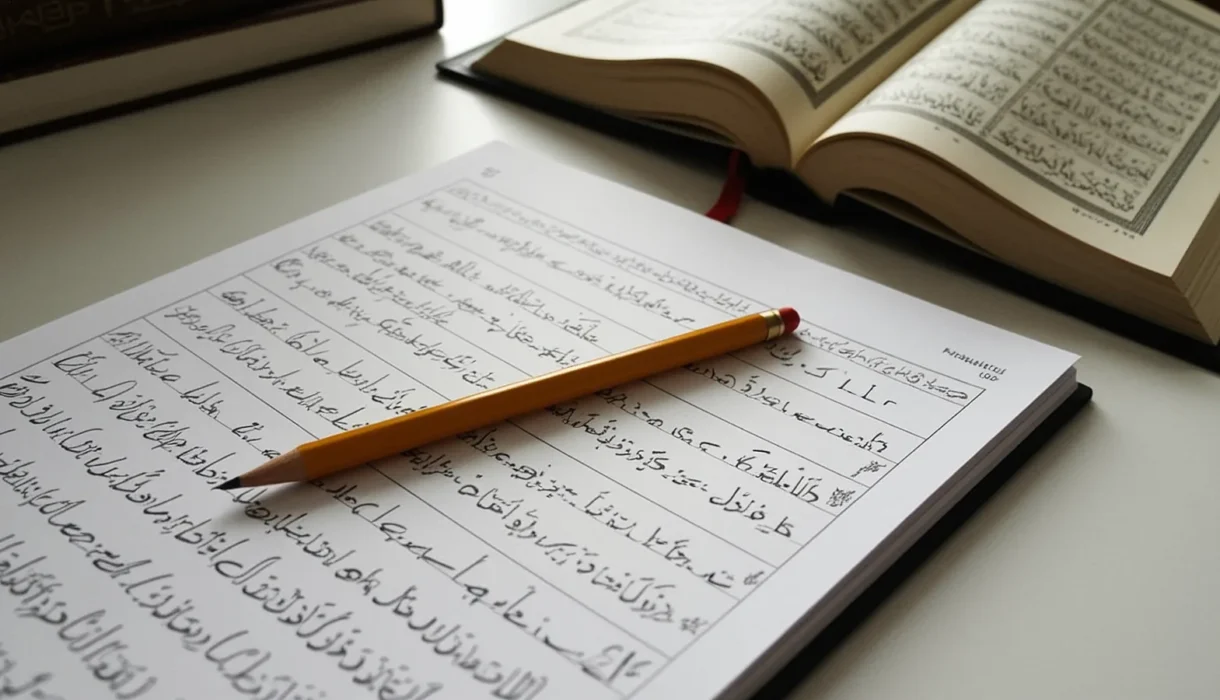

To learn Quran online for beginners, start with the Arabic letters and their sounds, then joined letters, then short words, then a short surah. Each stage should be readable before the next begins. Most beginners who stall were moved on too early, not taught too slowly.
This is the order we use, why each step exists, and how long it usually takes an adult or an older child studying a few times a week. It is also the order a parent can check a teacher against, because each stage leaves visible evidence that it is finished.
The order matters more than the pace
Reading Arabic is cumulative. A student who cannot recognise a letter in isolation will not recognise it joined to three others, and a student who cannot read joined letters will not read a verse. Skipping a stage does not save time; it moves the confusion forward.
Pace, by contrast, is personal. Two students can take the same route at very different speeds and both arrive. The order is what should not be negotiated.
Stage 1: the letters and their sounds
Twenty-eight letters, each with a name and a sound, plus the shapes they take at the start, middle and end of a word. This is the foundation and it is worth being patient with.
Expect the first weeks to feel slow and repetitive. That is correct. A student who can name and sound every letter without hesitation has something the rest of the course depends on.
Stage 2: short vowels and joining
Vowels change a letter’s sound, and joining changes its shape. This is where reading starts to look like reading: two letters become a syllable, syllables become words.
This stage is usually the first place a beginner feels progress, because real words appear. It is also where a teacher’s ear matters most, since a mispronounced vowel is easy to miss on a video call and hard to unlearn later.
Stage 3: reading words and short verses
Once joined letters are secure, the student reads words, then short phrases, then a verse. Length increases before difficulty does: a longer passage of familiar words teaches more than a short passage of unfamiliar ones.
At this point a beginner should be reading aloud in every lesson, not listening to the teacher read. If most of the lesson is the teacher’s voice, the student is not practising the thing being taught.
Stage 4: the first surah, memorised and understood
Al-Fatihah is the usual starting point, because it is recited in every prayer. Reading it, then memorising it, then understanding it line by line gives a beginner something usable rather than something theoretical.
Short surahs follow. The aim is not volume; it is a student who can stand in prayer and recite correctly without help.
How long each stage takes
There is no honest single answer, but there are honest ranges. For an adult studying three times a week, the letters commonly take four to eight weeks, joining another four to six, and reading short verses a further two to three months.
Children vary more, and younger children vary most. A six-year-old may take twice as long as a nine-year-old on the same stage, and that is normal rather than a failure. What matters is whether the student is moving at all.
Practice between lessons decides the pace
Fifteen minutes on the days between classes is worth more than an extra lesson. Reading is a physical skill as much as a mental one, and the mouth needs repetition that a twice-weekly lesson cannot supply.
Keep the practice short and specific: the same page, read aloud, three times. Vague instructions like “practise Quran” produce vague results, and a student who is unsure what to do will usually do nothing rather than ask.
What beginners should not worry about yet
Tajweed terminology, memorisation targets and perfect pronunciation can all wait. A beginner who is told about ghunnah and qalqalah in week one is being given vocabulary, not skill.
The single goal of the beginner stage is fluent, correct letter recognition. Everything else is built on it later, and none of it is lost by waiting.
It is also worth saying that adult beginners are not behind. They usually read instructions more carefully, tolerate repetition better, and can practise without supervision. What they often lack is confidence, which is why a one-to-one setting suits them: mistakes stay private, and the lesson can move at their pace rather than a class average.
Choosing a teacher for a beginner
Look for a teacher who assesses before teaching, corrects in the moment, and gives a specific practice task each lesson. Patience matters, but patience without correction is just encouragement.
The free trial is three lessons, which is enough to see whether the student is being heard. Use all three before deciding, and treat the third as the one where you ask what the student should be able to do in three months.
Price should come last. Read what the monthly fee covers once you know the frequency you need, not before, because the plan follows the week rather than the other way round.
If you are ready to plan the week, read how to start online Quran classes. If you want to know what the first workbook stage looks like, see the Noorani Qaida course. The free trial class is the low-risk way to test a teacher, and the courses show the full route from letters to recitation.
Questions before you book?
Join the women-only WhatsApp community where new batches and study reminders are posted first.
Join the WhatsApp Community
Aalima Warisha is an Aalima and Quran teacher at ATF Vision Islamic Institute.
View All Articles