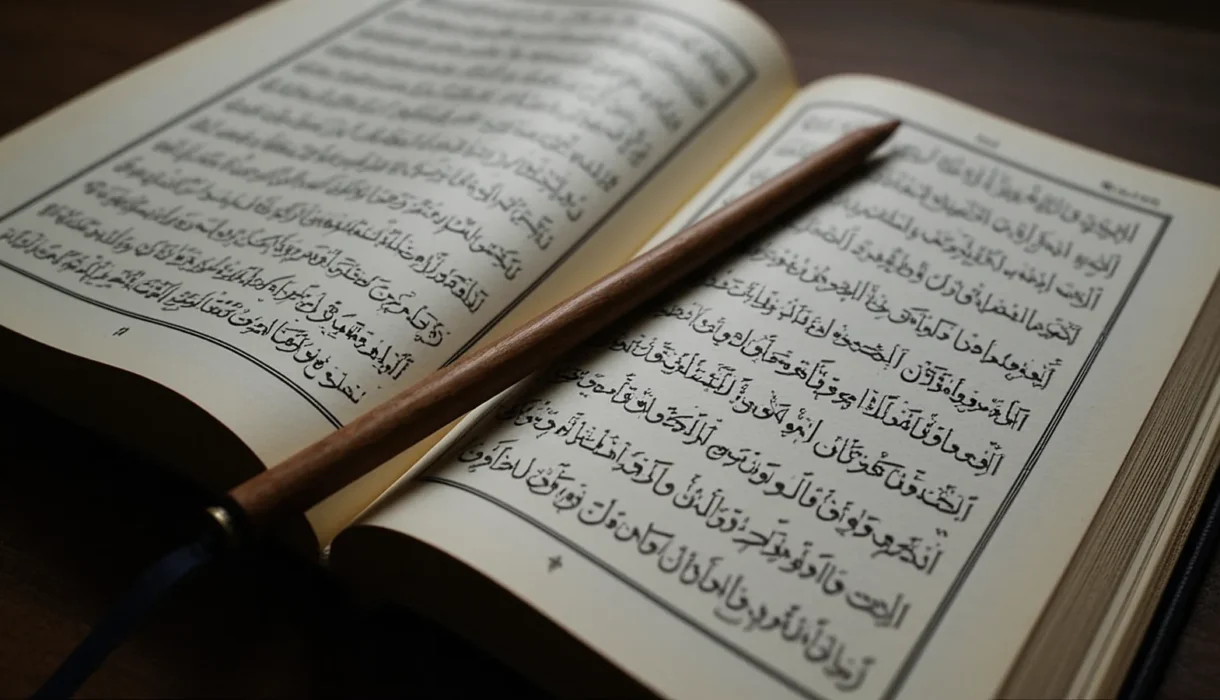

A Noorani Qaida online course teaches a beginner to read Arabic before they read the Quran. It moves through letters, joined forms, vowels, then the marks that change pronunciation, and it is finished when the student can read a page of the Quran slowly and correctly without help.
It is the most common starting point for children and for adult beginners, and it is worth understanding what the book actually contains before choosing a course, because a great deal of confusion comes from courses that skip pages quietly.
What Noorani Qaida is, and what it is not
It is a reading primer. It contains the alphabet, the joined forms, the short and long vowels, sukoon, tanween, madd and the rules for stopping and starting. It is not a tafsir, not a memorisation programme, and not a tajweed reference beyond the essentials.
That distinction matters. A student who finishes Noorani Qaida can read; they are not yet a reciter. Tajweed proper comes after, and expecting it before is one reason beginners feel they are failing when they are on schedule.
The order inside the book
The sequence is cumulative and should not be rearranged:
- Individual letters and their names.
- Joined letters — initial, medial and final forms.
- Short vowels — fathah, kasrah, dammah.
- Long vowels — the madd letters.
- Sukoon and closed syllables.
- Tanween and the doubled marks.
- Rules for stopping and the small marks above the line.
Each page assumes the one before it. A student pushed past a weak page will read the next one badly, and the weakness compounds.
How long the course takes
For a child studying three times a week, six to nine months is a normal range. An adult studying the same frequency often moves faster, because adults tolerate repetition and can read instructions.
Two things compress the timeline more than extra lessons: fifteen minutes of daily reading aloud, and a teacher who makes the student read rather than reading to them.
What a good online lesson looks like
Thirty minutes, one student, one teacher. The student reads; the teacher listens and corrects; the page is marked; the next task is set. The teacher’s voice should be a minority of the lesson.
Online, the microphone is the critical piece of equipment. Letter exit points and vowel lengths are exactly the details a poor connection hides, so a headset is worth more than a better camera.
What you need before the first lesson
The book itself, either printed or on screen, and a headset. That is the whole list. A printer is not required, and no app is needed; the primer works on paper and has done for decades.
It also helps to decide, before lesson one, who will sit with a younger child. A six-year-old can attend alone for ten minutes and then loses the thread. An adult in the room, saying nothing, keeps the lesson on the rails.
How much practice between lessons
Fifteen minutes on the days between classes is the single biggest factor in how fast the primer is finished. Reading aloud is a physical skill, and the mouth needs repetition that three lessons a week cannot supply.
Keep it narrow. The same page, read aloud three times, is better practice than a vague instruction to revise. A parent can hear whether the page is being read or guessed at, and that is enough to know if the practice is working.
How to tell a child is ready to move on
Not by page number, and not by how long they have been studying. Use three tests:
- Can they read an unseen page of joined letters without prompting?
- Do they self-correct when a vowel is wrong?
- Can they read a short Quran verse slowly, with the teacher silent?
Three yeses means the primer has done its job. Two means another few weeks on the same material will save months later.
Common mistakes in online Qaida teaching
The most common is speed for its own sake: a page a lesson because it looks like progress. The second is teaching rules before reading, so a child can recite the definition of ghunnah and still cannot read the word.
The third is a quiet one: letting the teacher read the page and the child repeat. Repetition after a model is not reading, and it hides exactly the errors the lesson exists to find. A parent listening for one thing — whose voice is doing the reading — will catch it within minutes.
What comes after the Qaida
Reading from the Quran itself, slowly at first, with the teacher correcting. Then a first short surah, memorised and understood, so the reading has a purpose the student can feel.
Tajweed as a subject comes after that, built on reading that already works rather than taught alongside it.
Is it suitable for adults?
Yes. Adults often move through the primer faster than children and prefer the privacy of one-to-one lessons. The book does not assume a child, even though it is usually taught to one. An adult who never learned Arabic as a child is doing exactly what the primer was written for.
For a child, read the guidance on safeguarding in online Quran classes first. To see where the primer sits in the wider route, read where a beginner begins, or plan the first week. The free trial is the cheapest way to test a teacher, and the courses show what follows the primer.
Questions before you book?
Join the women-only WhatsApp community where new batches and study reminders are posted first.
Join the WhatsApp Community
Aalima Warisha is an Aalima and Quran teacher at ATF Vision Islamic Institute.
View All Articles